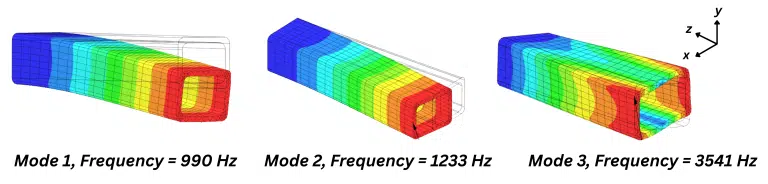
FEA Modal Analysis. Three vibration mode shapes of a hollow rectangular beam showing Mode 1, Mode 2, and Mode 3 with color-coded deformation patterns from blue (minimal displacement) to red (maximum displacement)

Vibration

FEA Modal Analysis: Mode Shapes & Natural Frequencies

Modal analysis is the backbone of structural dynamics. Learn to predict natural frequencies, understand mode shapes, and validate your FEA models against experimental data.
Block diagram showing frequency response function H(ω) as transfer function between input excitation F(ω) and output response X(ω) in frequency domain analysis

Vibration

Frequency Response Function: Complete Theory & Applications Guide

Master vibration analysis. Learn how Frequency Response Functions (FRF) characterize system dynamics, identify resonance, and enable precise modal analysis and structural health monitoring.
Comparison of sinusoidal vs random vibration in time domain showing predictable sine wave pattern versus unpredictable random signal, with corresponding frequency domain representations

Vibration

The total Guide to Random Vibration Analysis and Power Spectral Density (PSD) in 2025

Stop using FFT for random vibration. Discover why Power Spectral Density (PSD) is the industry standard for accurate testing and how to interpret g²/Hz.
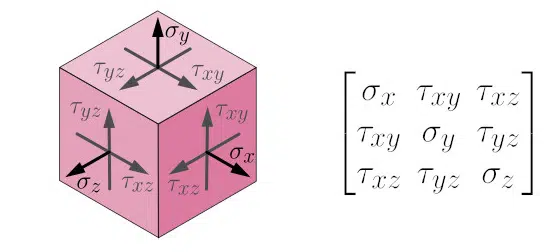
3D Mohr's Circle Calculator stress cube showing normal and shear stresses with corresponding stress tensor matrix

FEA

3D Mohr’s Circle Calculator

Visualize complex 3D stress states instantly. Compute principal stresses, maximum shear, and failure criteria like Von Mises with our interactive, professional-grade Mohr’s Circle calculator.
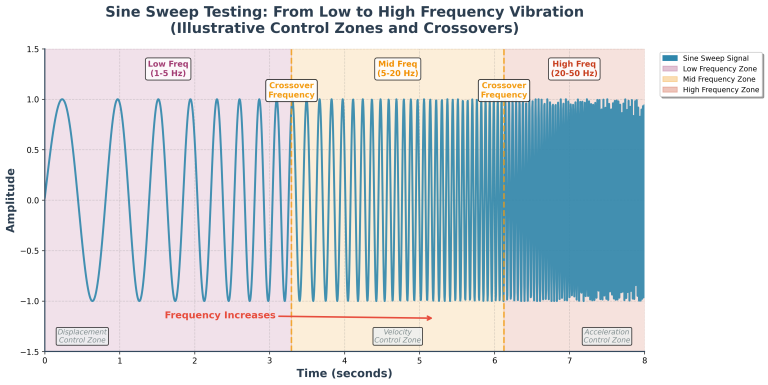
sine sweep testing logarithmic frequency progression vibration analysis displacement acceleration control zones

Vibration

Sine Sweep Testing: A Practical Guide to Vibration Analysis

Don't just find resonance—quantify it. Go beyond modal analysis with this guide to sine sweep testing, control strategies, and interpreting Frequency Response Functions (FRF).
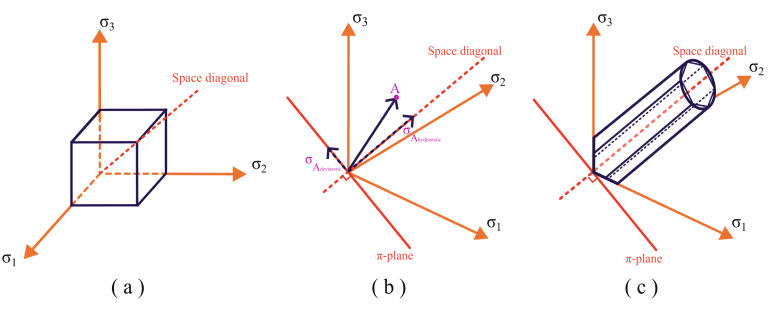
Yield criteria in space: a) space diagonal for a cube element, b) Hydrostatic and distortional components of stress in space diagonal and pi-plane, c) Von-mises and Tresca surfaces in the space

FEA

Yield Criteria under Combined Loading ​

From simple tension tests to complex components: discover how to use yield criteria to accurately predict structural failure and validate your finite element analysis results.
Title slide displaying 'Ramberg-Osgood: Stress-Strain Curve Approximation' in large black text on a light gray background

FEA

How to Model True Stress–Strain Curves with missing strain hardening coefficient for plastic deformations

Missing strain hardening data? Learn to approximate true stress-strain curves for ductile materials in FEA using the alternative Ramberg-Osgood method and simple tensile properties.
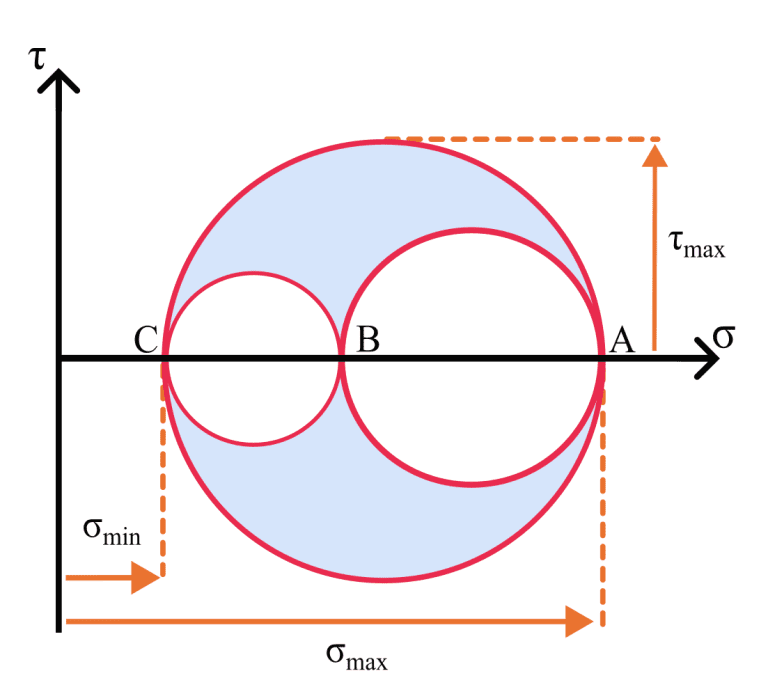
biaxial laoding-Mohr circle-maximum shear

FEA

Mohr’s Circle Analysis

Simplify complex stress analysis. Learn to use Mohr’s Circle to visualize stress states, find principal planes, and predict material failure without lengthy algebraic calculations.
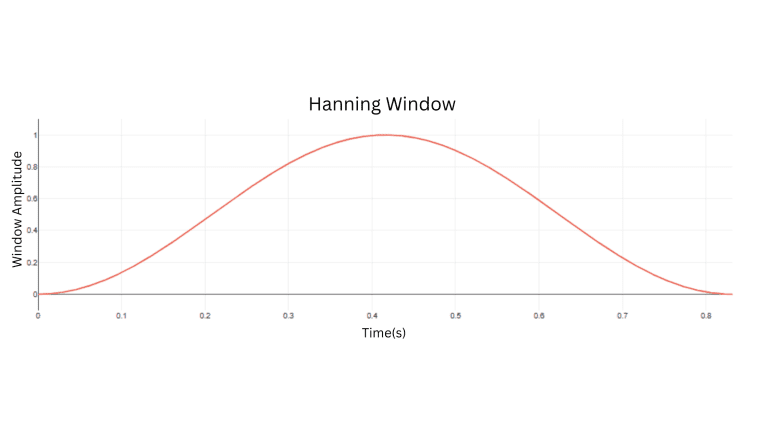
Plot of a Hanning window function over an 0.83 s time interval, smoothly tapering from zero at the start to a peak at mid-window and back to zero at the end

Vibration

Windowing in FFT: Improve Accuracy Using Hanning vs Rectangular Windows

See spectral leakage vanish. Use our interactive plots to visualize how Hanning windows taper signals and improve FFT accuracy compared to Rectangular windows.
Scroll to Top