How to Perform Stress Transformation with Mohr’s Circle
Learn graphical Mohr circle method can be used to obtain maximum and principal stresses and maximum shear stress for different cases of single and combined loading in plane stress
Mohr’s analysis, particularly through the use of Mohr’s Circle, is a fundamental graphical method for visualizing and calculating the state of stress at a point within a material. Its importance lies in its ability to simplify the complex process of stress transformation, allowing engineers to easily determine the principal stresses—these are the maximum and minimum normal stresses acting on planes where the shear stress is zero. By plotting normal and shear stresses on a coordinate system, Mohr’s Circle provides a clear visual representation from which one can directly read off the values and orientations of the principal stresses and the principal planes without resorting to lengthy algebraic calculations. This capability is crucial for predicting material failure, understanding deformation, and ensuring safe and efficient design in fields like mechanical, structural, and geotechnical engineering.
In this blog, the concept of Mohr’s circle is explained and the way to calculate the principal stresses and maximum shear stress for a few simplified examples is presented.
Mohr’s circle analysis
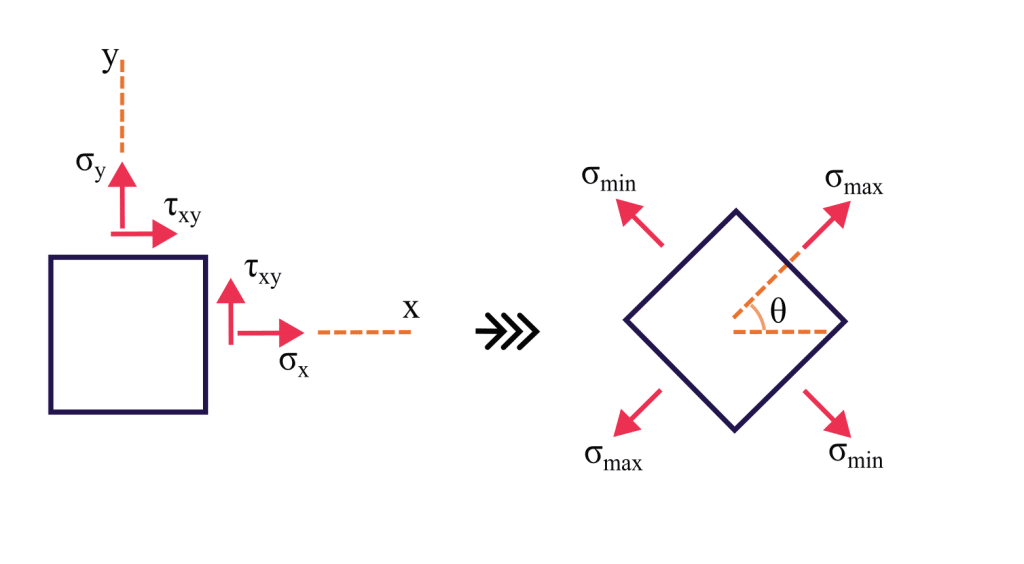
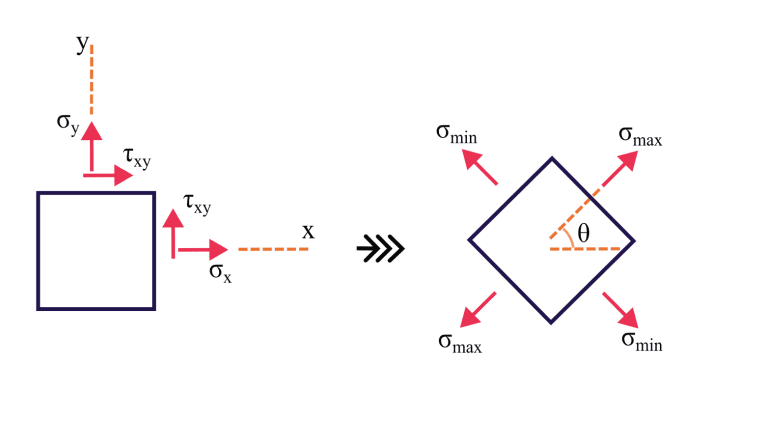
If an element in a plane is subjected to normal stresses of ($\sigma_{x}$) and ($\sigma_{y}$) and a shear stress of ($\tau_{xy}$) and the element would be rotated arbitrarily, the normal and shear stresses change depending on the degree of rotation ($\theta$) as shown in Figure-1:
$$\sqrt{\Bigl(\tfrac{\sigma_x – \sigma_y}{2}\Bigr)^2 + \tau_{xy}^2}$$
Mohr circle states that for a given degree of rotation the obtained normal and shear stresses lie on a circle in a coordinate with the normal stress and shear stress as x and y axes, respectively. The points X(($\sigma_x, -\tau_xy$)) and Y (($\sigma_y, \tau_xy$)) would be drawn on a normal-shear stress coordinate as shown, in Figure 2-a, with a convention of tension and compression stresses positive and negative, respectively, and positive shear stress in clockwise direction. A circle containing both these points could be drawn where a center point of ($\frac{\sigma_x + \sigma_y}{2}$) and a radius of ($\sqrt{\left( \frac{\sigma_x – \sigma_y}{2} \right)^2 + \tau_{xy}^2}$), shown in Figure 2-b. It needs to be noted that the rotation angle in the mohr circle is twice as the rotation angle of the element in plane stress, meaning a rotation of the element in plane stress is equivalent of twice the same rotation (2) in Mohr circle.
If the elements would be rotated in a way that the shear stresses exerted on the element would be zero, the two normal stresses points A and B are known as principal stresses, shown in Figure 2-c, representing the status where normal stresses exerted on the element are maximum and minimum. Also, the direction of the principal stresses are known as axes of principal stress. On the other hand, at the point C or D (Figure 2-c) the elements have the highest shear stress with opposite signs and a normal stress equivalent to the center of the circle. The Mohr circle would be very useful to obtain the maximum shear stress in simple cases of uniaxial normal stresses or torsion tests.
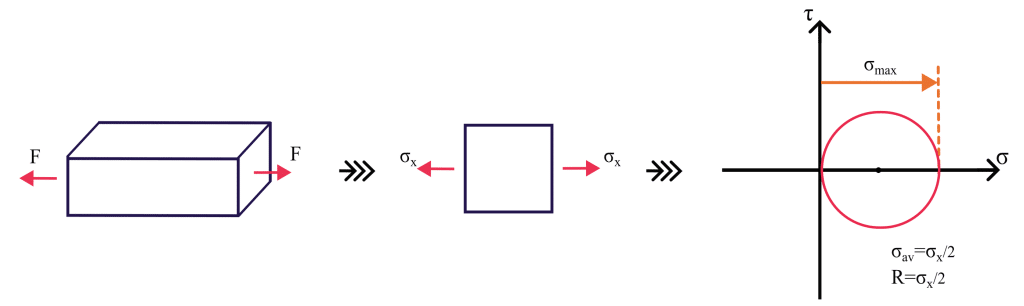
For instance, in a uniaxial test, illustrated in Figure 3, where the element in plane stress is subjected to a uniaxial tensile stress the Mohr circle could be obtained as below with the center of ($\frac{\sigma_x}{2}$) and a diameter of ($\frac{\sigma_x}{2}$). In this case, the maximum shear stress would be obtained with a rotation of 90 degree on the Mohr circle and thus a rotation of 45 degree for the element in plane stress.
As an another example where the element in plane stress is subjected to pure shear, as in torsion test illustrated in Figure 4, the Mohr circle could be drawn with a center of zero and a radius of ($\frac{\tau_xy}{2}$).
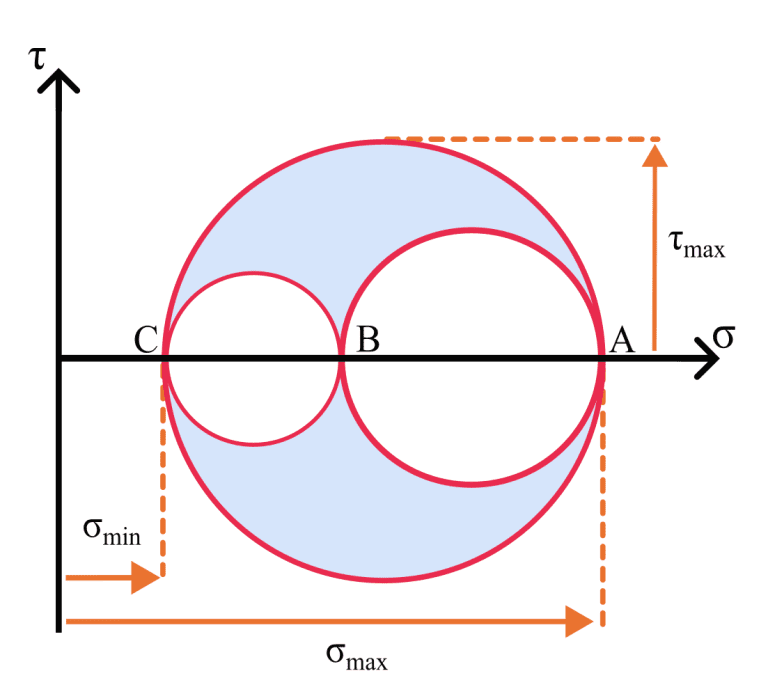
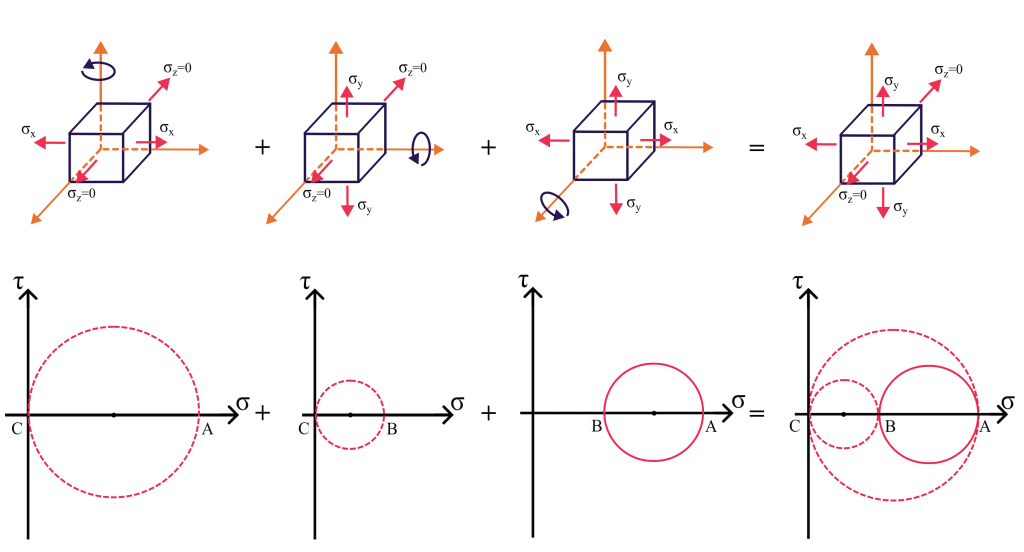
In order to use the Mohr circle concept for a three-dimensional element subjected to the stresses in all three dimensions, the element needs to be rotated about their axes of principal stress. In this way, as long as the rotation is about an axis of principal the shear stresses on the plane perpendicular to that axis is zero and the principal stress in the direction of the axis does not play a role in the transformation. Thus, the Mohr circle concept in plane stress could be used for the rotation about three axes of principal separately. As an example as shown in Figure 5, the Mohr circle with diameter AB corresponds when the element is rotated about the c axis. In this condition, the shear stresses on the element surface parallel to plane ab and perpendicular to axis c are zero. The rotation about other axes of a and be forms the circles with diameter BC and CD, respectively.
In this condition the maximum shear stress of the material is equal to the radius of the circle with the largest diameter. In another word, when analyzing the transformation of stresses to find the maximum shear, it needs to see that the rotation of the element about which axis of principal gives the largest shear stress.
$$\tau_{max} = \frac{1}{2} \left( \sigma_{max} – \sigma_{min} \right)$$
In a three-dimensional element subjected to two normal stresses of ($\sigma_1$) and ($\sigma_2$) while ($\sigma_3=0$) and ($\tau_{31}=\tau_{32}=0$), the z axis is one of the principal axes since the shear stresses in the plane perpendicular to axis z are zero. When the principal stress in z direction is zero, this means that the two Mohr circles corresponding to the rotation about axes of 1 and 2 have one of their principal stresses crossing the origin ($\sigma_{3} = \tau_{31} = \tau_{32} = 0$).
In cases where the two normal stresses are in the same direction, both tensile stress or both compressive stress, the rotation about axis 3 does not form the largest circle. The largest circle is one of the circles formed by the rotation about axis 1 or axis 2.
In this blog, the concept of Mohr’s circle is explained and the way to calculate the principal stresses and maximum shear stress for a few simplified examples is presented. If you’re new to stress transformation, also check out our deep-dive on yield criteria for more background.
Amir Abdi holds a PhD in Mechanical Engineering from KTH Royal Institute of Technology, specializing in heat transfer improvement in latent thermal energy storage. He has two years of experience as a CAE Engineer at Scania’s Industrial Operations Asia division and currently works as a Climate Engineer at Envirotainer Engineering AB. Amir’s professional interests include structural mechanics, finite element analysis (FEA), computational fluid dynamics (CFD), and advanced heat transfer. His background combines hands-on engineering experience with in-depth research, enabling him to tackle complex industrial and technological challenges in energy and climate control systems.