
Bolt Types Explained: Complete Classification & Applications Guide
Key Takeaways
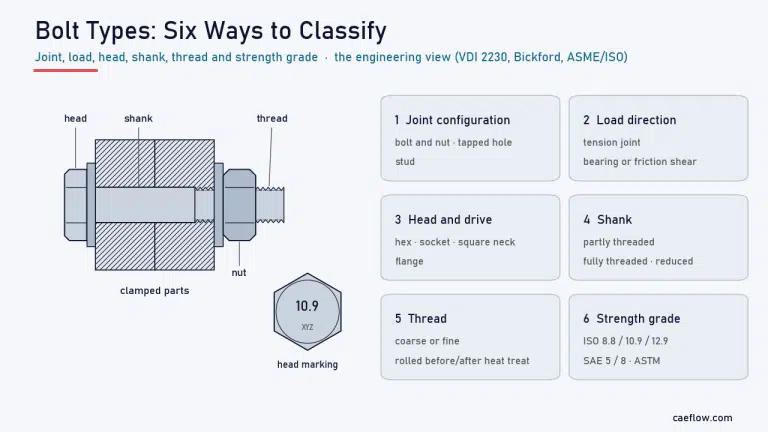
Bolt or screw: a bolt passes through holes and is tightened by turning a nut; a screw is tightened by its head into an internal thread.Six features sort bolt types: joint, load direction, head, shank, thread and grade.
Class 8.8 means a nominal tensile strength of 800 MPa and a nominal yield-to-tensile ratio of 0.8.
Table of Contents
- Key Takeaways
- Introduction
- What Is a Bolt?
- How Are Bolts Classified?
- Bolt Types by Joint Configuration
- Tension Joints and Shear Joints
- Common Bolt Head Types and Their Uses
- Shank and Thread Types
- Bolt Strength Grades
- Worked Example: Three Shank Types in One Joint
- How to Choose the Right Bolt Type
- Conclusion
- FAQ
- References
Introduction
Catalogues list dozens of bolt types, and most guides stop at names and pictures. For a design engineer that is not enough: the bolt type also decides how stiff the bolt is, how much service load it carries and how it fails.
This guide classifies bolts the way the engineering references do, using Bickford's joint types, VDI 2230 and the ASME, ASTM, SAE and ISO standards collected in Machinery's Handbook. It ends with a worked VDI 2230 example and a selection checklist.
What Is a Bolt?
A bolt is an externally threaded fastener designed to pass through holes in assembled parts and normally tightened or released by turning a nut. A screw mates with a preformed or self-formed internal thread and is tightened by turning its head (ASME B18.2.1, quoted in Machinery's Handbook).
The difference lies in the intended installation, not only the shape. Two practical rules follow. A fastener that cannot be turned during assembly, such as a carriage bolt, is a bolt. A fastener whose thread cannot take a standard nut, such as a wood screw, is a screw.
How Are Bolts Classified?
No single standard lists every bolt type, so engineers sort them by the features that change how a joint behaves (Table 1).
Bolt Types by Joint Configuration
VDI 2230 Part 1 calculates three single-bolt configurations (Figure 1):
- Through-bolted joint (bolt and nut). The bolt passes through clearance holes and a nut clamps from the far side. A deformation cone spreads from each side (joint coefficient w = 1).
- Tapped thread joint (screw). The screw threads into one clamped part, so only one side needs access. The cone grows from the head only (w = 2), and the engaged thread uses a substitutional length of 0.33d instead of 0.4d for a nut.
- Stud-bolted joint. A stud is screwed into a tapped hole and a nut clamps the parts; VDI models its nut zone as for a bolt and nut.

Figure 1. The three single-bolt joint configurations in VDI 2230 (schematic).
The configuration changes the joint stiffness and therefore how a service load splits between bolt and clamped parts. VDI 2230 also distinguishes concentric from eccentric clamping. The interactive bolted joints guide shows the stiffness calculation step by step.
Tension Joints and Shear Joints
Bickford classifies bolted joints by the direction of the service load. In a tension joint the load acts roughly parallel to the bolt axis, and the bolts must clamp hard enough to stop the parts separating or leaking. In a shear joint it acts roughly perpendicular to the axis. Bickford calls the tension joint the more common and more complex type.
Shear joints work in one of two ways. In a bearing joint the bolt acts as a shear pin and the exact preload is not critical. In a friction (slip-critical) joint, heavily tensioned bolts clamp the parts so that friction resists slip. VDI 2230 makes the same split between slip-resistant and shearing/hole-bearing joints, and in principle allows no slip.
Common Bolt Head Types and Their Uses
The head decides which tool tightens the bolt, how large the bearing area is and whether the bolt can turn during assembly. Table 2 lists the types engineers meet most often, and Figure 2 shows their profiles.

Figure 2. Bolt types chart: side profiles of common bolts, screws and studs (schematic, not to scale).
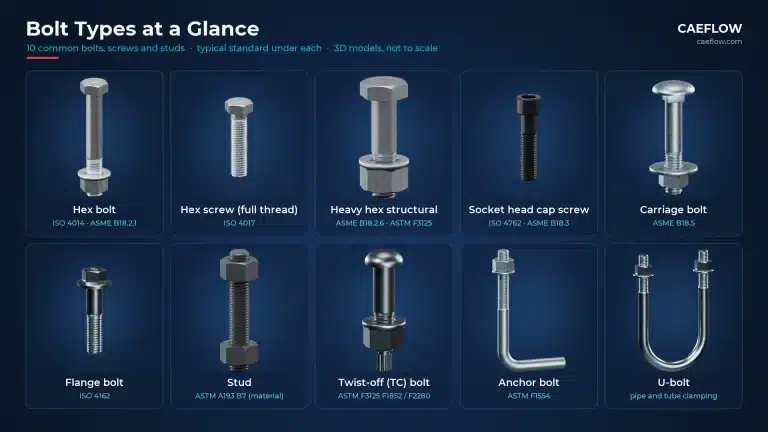
Bickford notes that a twist-off bolt is really torque control: its spline snaps off at a set torque, so preload still depends on friction and the torque–tension relationship must be calibrated.
Shank and Thread Types
The shank sets the bolt's elastic compliance, which VDI 2230 adds up element by element (Eq. 5.1/3):
$$\begin{aligned} \delta_S &= \delta_{SK} + \sum_i \frac{l_i}{E_S A_i} \\ &\quad + \delta_{Gew} + \delta_{GM} \end{aligned}$$
The head term uses a substitutional length of 0.5d for hex heads and 0.4d for socket head cap screws. Three shank types are common:
- Partly threaded (full shank). Plain shank at the nominal diameter, as in ISO 4014; the stiffest option for a given clamp length.
- Fully threaded. Thread over the whole length, as in ISO 4017. The thread core is thinner than the shank, so this bolt is softer.
- Reduced shank (waisted). The shank is turned below the thread minor diameter, typically $d_T = 0.9\,d_3$ (VDI Table A12). VDI Table A13 lists this anti-fatigue shank as a way to raise bolt compliance. ISO 4015 bolts, with a shank near the pitch diameter, are a milder version where the thread usually stays the weakest section.
For threads rolled before heat treatment, VDI 2230 gives the fatigue limit (stress amplitude at 2×10⁶ cycles, mean load 0.3–1.0 of the yield load) as
$$\sigma_{ASV} = 0.85\left(\frac{150}{d} + 45\right)\ \text{MPa}$$
which is 48.9 MPa for M12. Threads rolled after heat treatment have a higher fatigue limit thanks to residual compressive stress. In class 12.9, fine threads can have an up to 30% lower fatigue limit than standard threads, and hot-dip galvanising lowers it by about 20%.
Bolt Strength Grades
Metric bolts carry an ISO 898-1 property class. In class a.b, the first number times 100 is the nominal tensile strength in MPa, and the second divided by 10 is the nominal yield-to-tensile ratio:
$$\begin{aligned} R_{m,\text{nom}} &= 100\,a\ \text{MPa} \\ R_{p,\text{nom}} &= R_{m,\text{nom}} \cdot \frac{b}{10} \end{aligned}$$
Class 8.8 therefore means 800 MPa and 640 MPa; for some classes the specified minimums are slightly higher (Table 3). Inch bolts use SAE J429 grades or ASTM specifications. The bolt grade chart shows how to read head markings and which nut and torque go with each grade.
A325 and A490 are now grades of ASTM F3125. VDI 2230 requires the bolt to break before the nut thread strips, and Machinery's Handbook advises a nut of the same or a higher grade than the bolt.
Worked Example: Three Shank Types in One Joint
Bolted joints · Worked example
How the shank type changes an M12 bolted joint
M12×1.75 class 10.9 hex bolt with nut, two 25 mm steel plates ($l_K$ = 50 mm), $d_W$ = 16.63 mm, $d_h$ = 13.5 mm, $D_A'$ = 40 mm, E = 205 GPa. The service load cycles from 0 to $F_A$ = 15 kN, introduced under head and nut (n = 1, an upper bound). Bolt A is fully threaded; B has a 40 mm plain shank and 10 mm of free thread; C has an 8.87 mm waist instead of the plain shank (transition radii ignored).
Step 1 · Stiffness
Resilience of the plates and the three bolts
$$\delta_P = 7.23 \times 10^{-7}\ \text{mm/N}$$
Result: bolt stiffness $k_S$ = 247 (A), 311 (B) and 215 (C) kN/mm.
Step 2 · Load share
Load factor and thread stress amplitude
$$\begin{aligned} \Phi &= \frac{\delta_P}{\delta_S + \delta_P} \\ \sigma_a &= \frac{\Phi F_A}{2A_S} \end{aligned}$$
Result: with $A_S$ = 84.3 mm², Φ = 0.152, 0.184 and 0.135, and $\sigma_a$ = 13.5, 16.3 and 12.0 MPa.
Step 3 · Comparison
Reduced shank versus plain shank
Bolt C is 31% softer than B and cuts the thread stress amplitude by 27%, but its yield load is also 27% lower (58 vs 79 kN in VDI Tables A11 and A12).
Result: the reduced shank trades static capacity for fatigue resistance, which pays off at higher service loads.

Figure 3. Worked example: bolt stiffness, thread stress amplitude and yield load for the three shank types (VDI 2230 model).
How to Choose the Right Bolt Type
- Fix the joint configuration: through holes with a nut, a tapped hole or a stud.
- Identify the load path: tension, bearing shear or slip-critical shear.
- Pick the strength grade and a matching nut.
- Choose the head for tool access, bearing pressure and anti-rotation.
- Choose the shank: a full shank in a shear plane, a reduced shank for long, fatigue-loaded tension joints.
- Check corrosion, temperature and coating.
- Verify critical joints with VDI 2230, plus tests or FEA as the guideline recommends.
Conclusion
A bolt type is more than a head shape. Joint configuration, load direction, shank, thread and grade decide how a bolt shares load, resists fatigue and fails. Start from the joint, narrow the product with the standards and check it with VDI 2230.
FAQ: Common Questions About Bolt Types
What are the main types of bolts?
Common types are hex bolts, hex screws, structural bolts, socket head cap screws, carriage bolts, flange bolts, studs, twist-off bolts and anchor bolts. Engineers also group them by joint, load, shank, thread and grade.
What is the difference between a bolt and a screw?
Under ASME B18.2.1, a bolt passes through holes and is tightened by turning a nut, while a screw mates with an internal thread and is tightened by its head. A carriage bolt cannot turn, so it is a bolt; a wood screw cannot take a nut, so it is a screw.
What does 8.8 on a bolt mean?
It is the ISO 898-1 property class: a nominal tensile strength of 8 × 100 = 800 MPa and a nominal yield-to-tensile ratio of 0.8, so the nominal yield strength is 640 MPa.
What is the strongest bolt grade?
Of the common grades here, ISO class 12.9 is the strongest, with a minimum tensile strength of 1220 MPa. SAE Grade 8 and ASTM A490 follow at 150 ksi (1034 MPa).
What is a reduced-shank bolt used for?
A reduced-shank bolt has a shank thinner than the thread core, typically 0.9 times the minor diameter. It is more elastic, so it carries a smaller share of an alternating load and loses less preload to embedding.
References (clickable):
- Bickford, J. H. (2008). Introduction to the Design and Behavior of Bolted Joints: Non-Gasketed Joints, 4th ed. CRC Press.
- VDI 2230 Part 1 (2003). Systematic calculation of high duty bolted joints. VDI.
- Oberg, E. et al. (2020). Machinery's Handbook, 31st ed. Industrial Press.
- ISO 898-1:2013. Mechanical properties of fasteners, Part 1.
- ASTM F3125/F3125M. High strength structural bolts and assemblies.
