
Bolt Grade Chart: How to Read Markings and Choose the Right Grade
Key Takeaways
Bolt grade: sets the minimum strength of the bolt material, not its size or thread.Class 8.8 means 800 MPa nominal tensile strength and a yield-to-tensile ratio of 0.8.
SAE markings: radial lines on the head, three for Grade 5 and six for Grade 8.
Torque: a stronger grade adds clamp force only if the tightening torque rises with it.
Introduction
You pick up a bolt and see "10.9" or six small lines on the head. This guide shows how to read that bolt grade, gives a chart with the values you design with, and lists the rules that prevent the most common mistakes.
What Is a Bolt Grade?
A bolt grade is the strength rating of a bolt's material. It guarantees minimum proof, yield and tensile strengths set by a standard: ISO 898-1 property classes for metric steel bolts, SAE J429 grades for inch bolts and ASTM specifications for structural bolts. It says nothing about size, thread or coating.
How to Read Metric Bolt Grades
In a metric class a.b, the first number times 100 is the nominal tensile strength in MPa, and the second number divided by 10 is the nominal yield-to-tensile ratio:
$$\begin{aligned} R_{m,\text{nom}} &= 100\,a\ \text{MPa} \\ R_{p,\text{nom}} &= R_{m,\text{nom}} \cdot \frac{b}{10} \end{aligned}$$
So 8.8 means 800 MPa tensile and 640 MPa yield. Design with the specified minimums in ISO 898-1, which are higher than nominal for some classes (1040 MPa, not 1000 MPa, for 10.9).
The highest force a bolt must carry without permanent set is its proof load, $F_p = S_p A_s$ (proof stress times tensile stress area). For an M12 bolt ($A_s$ = 84.3 mm²) that is 48.9 kN in class 8.8 and 70.0 kN in class 10.9.
Bolt Grade Markings
Figure 1 shows the head markings you meet most often.

Figure 1. Bolt grade markings on metric and SAE hex heads (schematic).
- Metric bolts carry the class number (8.8, 10.9, 12.9) and the manufacturer's mark.
- SAE bolts use radial lines: none for Grade 2, three for Grade 5, six for Grade 8. The number of lines plus two gives the grade.
- ASTM structural bolts carry the designation, such as "A325" or "A490", now grades of ASTM F3125.
- Stainless bolts use ISO 3506-1 codes such as A2-70: steel group A2 (close to AISI 304) and a minimum tensile strength of 700 MPa.
Treat an unmarked bolt as unknown and weak. Counterfeit fasteners look genuine, and Machinery's Handbook notes that only a test proves the grade.
Bolt Grade Chart
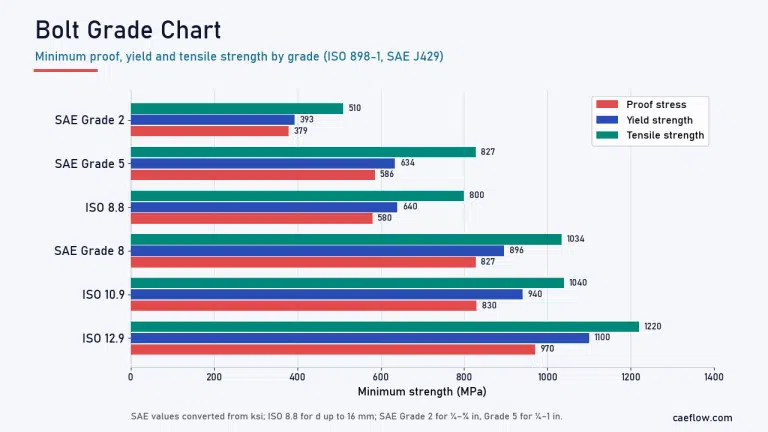
Table 1 lists the common grades. Values are minimums from ISO 898-1 and SAE J429 (as tabulated in Machinery's Handbook); MPa values for SAE grades are converted from ksi.
Grades 5 and 8 and classes 8.8 to 12.9 are quenched and tempered; Grade 2 is not. By strength, 8.8 is close to Grade 5 and 10.9 to Grade 8, but they are different standards and thread systems, so check each value when converting a drawing.
Same Bolt, Different Grade: What Changes
The grade sets how much preload a bolt can take; the wrench decides how much it gets. Table 2 gives VDI 2230 values for one M12 bolt tightened until the equivalent stress reaches 90% of minimum yield.
Going from 8.8 to 10.9 allows 47% more preload, but only with 46% more torque. A 10.9 bolt tightened to the 84 N·m written for 8.8 still gets about 43 kN, so the upgrade adds no clamp force. The reverse is worse: at 123 N·m an 8.8 bolt sees about 840 MPa of combined tension and torsion stress, far above its 640 MPa minimum yield, so it will yield and may break. The interactive bolted joints guide shows how friction drives these numbers.
Practical Rules for Choosing a Bolt Grade
- Use the lowest grade that passes the calculation, usually 8.8; go to 10.9 or 12.9 when space limits the bolt size.
- Match the nut: same or higher grade, i.e. ISO 898-2 classes 8, 10 and 12 for 8.8, 10.9 and 12.9, or SAE J995 Grade 5 and 8 nuts.
- Check the internal thread. Stronger bolts need longer engagement in soft parts: for helical inserts in a parent with 150 MPa shear strength, Machinery's Handbook asks for 2 diameters with 8.8 but 3 with 12.9.
- Watch the coating. Electroplating can cause hydrogen embrittlement, a risk that grows with hardness and matters most for 12.9. ISO 4042 sets the precautions; zinc-flake coatings (ISO 10683) avoid electrolytic hydrogen.
- Never change the grade alone. Update the drawing, the torque and the nut together.
- Remember stainless is weaker. A2-70 has a minimum yield of 450 MPa, against 640 MPa for 8.8.
Conclusion
Read the head, look up the minimum strengths and size the joint with them. Then make sure the nut, thread engagement, coating and torque all match the grade. To choose the bolt itself, see the bolt types guide.
Frequently Asked Questions
What does 8.8 on a bolt mean?
It is the ISO 898-1 property class: a nominal tensile strength of 800 MPa and a yield strength of 80% of that, 640 MPa.
Which is stronger, 10.9 or Grade 8?
They are very close. Class 10.9 has a minimum tensile strength of 1040 MPa and Grade 8 has 150 ksi (1034 MPa); 10.9 has the higher minimum yield, 940 MPa versus 896 MPa.
How do I identify a Grade 8 bolt?
An SAE Grade 8 bolt has six radial lines on its head, 60 degrees apart. Grade 5 has three lines and Grade 2 has none.
What is the strongest bolt grade?
Of the common grades, metric class 12.9 is the strongest, with a minimum tensile strength of 1220 MPa. It is typical for socket head cap screws.
Can I replace an 8.8 bolt with a 10.9 bolt?
Usually, but it only adds clamp force if you raise the torque to the 10.9 value. Use a class 10 nut and check the internal thread and coating.
References (clickable):
- ISO 898-1:2013. Mechanical properties of fasteners made of carbon steel and alloy steel, Part 1: Bolts, screws and studs.
- ISO 898-2. Mechanical properties of fasteners, Part 2: Nuts with specified property classes.
- ISO 3506-1:2020. Corrosion-resistant stainless steel fasteners, Part 1: Bolts, screws and studs.
- SAE J429. Mechanical and Material Requirements for Externally Threaded Fasteners.
- VDI 2230 Part 1 (2003). Systematic calculation of high duty bolted joints. VDI.
- Oberg, E. et al. (2020). Machinery's Handbook, 31st ed. Industrial Press.
- Bickford, J. H. (2008). Introduction to the Design and Behavior of Bolted Joints, 4th ed. CRC Press.
